
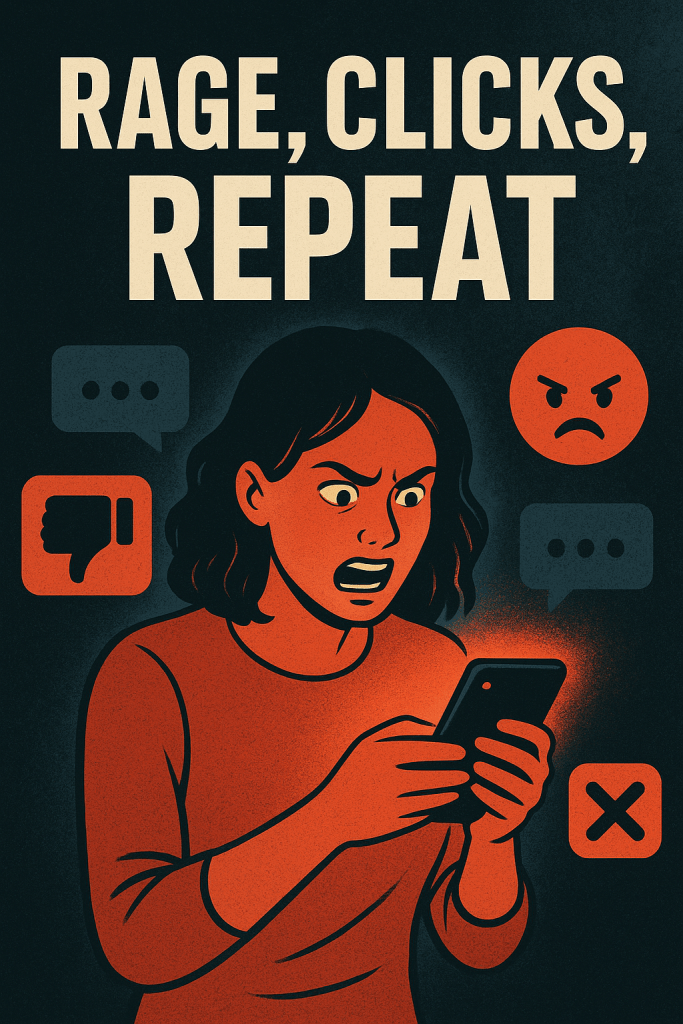
Algorithms — the foundation of the echo chambers we’re all living in. We know how social media works. We know what it’s doing to us. And still, there I am, consuming an endless stream of curated, monetized content, letting my brain chemistry react before my rational mind even shows up. Suddenly it feels like the world is full of idiots.
Recently, I unfollowed one of my closest longtime friends on Facebook. She’s a good person — I know that — but my feed became nothing but anger and accusation as she shared one polarizing post after another, each one framing people with my political views as ignorant, evil, or beyond saving. It wasn’t just that she believed what the algorithm told her about the world. She believed what it told her about me.
And on my side, the algorithm fed me the reverse: post after post insisting she must be the stupid one. The gullible one. The hateful one. That’s not how I want to see someone who once meant so much to me. So I deleted the Facebook apps on my phone and quietly unfollowed her. I still text her now and then — a small lifeline — but it doesn’t solve the problem. If I ever spoke openly about my politics, I know she’d sort me into a category. And I don’t want to put her into one.
When I was in college, my MySpace page could sit untouched for months. I could disagree with friends’ views without feeling like we were mortal enemies. Part of why things are different now is that so many people no longer recognize the three basic types of media we encounter: news, opinion, and sponsored content. Too many can’t tell the difference. It’s not just social media either; my parents watch a lot of 24-hour “news,” and I’ve watched them slide further into political extremes fueled almost entirely by opinion masquerading as information.
I loved the show Ted Lasso, especially that scene where Ted faces Rupert in a game of darts and delivers the perfect Yoda-level line: “Be curious, not judgmental.” I keep wondering: where did our curiosity go? When did we stop wanting to understand each other? Apparently, the algorithms were hungry.
Part of the reason we stay buried in ideological sand is addiction. I recently finished Dopamine Nation, and Dr. Anna Lembke captures it perfectly when she calls the smartphone the “modern-day hypodermic needle.” A constant drip of attention, validation, and distraction — a never-ending casino in our pockets. Behavioral addictions have surged since the early 2000s: TikTok spirals, Instagram scrolling, Tinder swiping, online gambling, e-shopping. The book is about pleasure, yes — but also about pain, and the delicate balance between them that we now desperately need to reclaim.
Watching people who were once inseparable now refuse to speak because a glowing screen told them who the other “really” is… it’s disorienting. And frightening. I think about my kids and wonder: how do I protect them from this?
All I’ve come up with for now is no smartphones until after 8th grade. I even signed a pledge on waituntil8th.org and hope more parents choose the same. But for myself — how do I escape algorithm-induced rage at anyone who sees the world differently? The best I can do is limit the exposure. Look up more. Live more. Be here more.
“The present moment is a wonderful moment.” — Thich Nhat Hanh
I repeat this to myself on my daily walk. What’s happening politically in this country may be awful, but it’s still just one square inch of the world. My phone tries to convince me that that square inch is everything — the whole planet — and that the rest of life is the tiny corner.
So I walk the dog and say, “The present moment is a wonderful moment.” I pass neighbors smiling on their porches and say it again. I hear my kids’ laughter and repeat it. I put the phone down. Maybe I journal instead. Or blog, like this.
In the end, I’m learning that breaking free from the algorithm doesn’t require some dramatic digital detox or a grand gesture of enlightenment. It starts with small acts of presence — choosing curiosity over judgment, choosing real faces over glowing screens, choosing the world right in front of me over the one engineered to provoke me. If we can reclaim even a fraction of that presence, maybe the echo chambers lose some of their power. Maybe we remember who we are to each other. And maybe, just maybe, that’s how we begin to find our way back.


 Zenopause
Leave a comment